Ivor Casey, author of Elvis and Ireland and Bono in Dalkey
Irish rock star Bono and myself met recently at The Corner Note Café in Dalkey. When asked about his inclusion in the book, Bono, who has been reading his own personal copy, remarked that he was "delighted to be part of the whole thing". The book is set to be launched by Barry Devlin of Celtic Rock group "Horslips" on 10 May 2013 at The Corner Note Café.
"Elvis and Ireland" explores the life of Elvis and his influence and connections with Ireland. It is a social and historical study, documenting the evolution of rock and pop culture in Ireland, while simultaneously covering the entire story of Elvis's life, with some new fresh perspectives. Having been born over six years after Elvis died, my study of his life reflects a new generation of Elvis enthusiast.
Among the Irish influences and connections include Irish songs he sang and the listings of Irish singers who covered his work. It touches on his Irish genealogy and documents the Irish actors and singers he worked with and came in contact with throughout his life. It also details how Elvis and rock 'n' roll music was first received here by the establishment and how rock 'n' roll and popular music first formed in the country. There is also details about the movies of his which were censored and the Irish cinemas that first screened his films, as well as the Irish chart successes he had, among many many more interesting facts and trivia. "Elvis and Ireland" is available on Amazon and Barnes & Noble and is in print to order from other leading book stores.
Elvis and Ireland is the "Irish Biography" of Elvis Presley. It is the detailed story of Elvis Presley's life and career, combined with a timeline of events in Irish popular culture and the social changes brought on by his unique brand of rock 'n' roll.
What you will find here is just about everything to do with Elvis and his links with Ireland including anecdotes, entertaining trivia on Elvis's connection with Ireland, his Irish chart successes, as well as areas of censorship. You will also learn about Irish songs he covered and Irish singers who covered his work. Find out what many Irish personalities have to say about Elvis, as well as what was said about the star from the Dáil to the pulpit.
Elvis and Ireland focuses on how Irish artists used Elvis and American popular culture for their own artistic efforts, from Ireland's earliest showbands and beat-groups to the rock legends Rory Gallagher, Phil Lynott and Bono. It covers several decades of Irish popular music without ever losing track of Elvis's story. In brief this book is a view of Elvis Presley through Irish eyes.
Elvis and Ireland brings together the story of the global superstar from his birth to his untimely death, picking up the Irish connections along the way. To add a further Irish dimension, the book also features artwork of Elvis by three famous Irish artists. All music fans, and not just the Irish ones, will find this an exhilarating journey through the career of the universal music icon.
"Hundreds of Elvis books already exist but rarely does a new Elvis book have something to say from a totally different cultural stand point"
Westmeath is not usually considered when it comes to remembering the 1916 Rising but there is certainly one Westmeath man linked to the fight for an independent Ireland who had much involvement. In what is the 30th anniversary of his death, the man I refer to is Tomás Malone. Born in 1896, in Meedin, near Tyrrellspass, Tomás was the son of William and Máire Malone. He was educated at the Franciscan College, Multyfarnham and became qualified in Greek and Irish. However, his family’s deep Republican nature saw him take an interest in the struggle for Independence. In 1912, Liam Mellows, founder member of the Irish volunteers, enrolled him in ‘Na Fianna Éireann’ (The Republican boys movement) and the Malones would become a driving force of Republicanism in Co. Westmeath.
House of Tomás Malone in Meedin, Tyrrellspass, Co. Westmeath (Photo: Ivor Casey, 2006)
Tomás’ motivation was influenced largely by his mother. She had been a national school teacher, dismissed from her job for teaching children their prayers in Irish. She staged a sit in but was removed by the RIC (Royal Irish Constabulary) and the local Catholic priest. As a result she ended up teaching Irish to children in her home at night. Tomás’ connection with 1916 began when he heard of the events that were transpiring in Dublin. With his brothers, Séamus and Seosamh, and other Irish Volunteers he barricaded his home when police came to carry out a search. The defeat of Irish fighters in Dublin caused Malone to withdraw from his rebellion and he was arrested. Serving a sentence at three different jails including Kilmainham Gaol, he came in contact with other like minded Irish Republicans. After release from prison he was elected to the Army Council of the Volunteers and in 1918 combined this occupation with the native tongue as he began teaching Irish while he travelled the country. Malone was deeply affected by the ideals which inspired the Irish language movement. As well as preserving, arguably, the country’s most important source of identity from Great Britain he used his teaching of the Irish language as a method of recruiting other "freedom fighters".
Tomás took on the alias of Sean Forde, as he became deeply involved in the Republican movement, arranging and committing ambushes on British forces. He eventually became a Commandant, based in East Limerick and he helped establish the first Flying Column in Ireland. Tomás played a major part in bringing about the surrender of Ballylanders RIC barracks on 27 April 1920. He felt it was ‘the biggest such attack’ undertaken by the column. It lasted several hours, in which two RIC men were killed and eight wounded, while one Republican was killed and two were injured. Tomás also headed the attack on Killmallock barracks, in which it was burned to the ground. His column also succeeded in an attack against military forces at Grange, between Bruff and Limerick City.
In December 1920, Malone was caught and sent to prison on Spike Island off the Cork coast, but the prison authorities were not aware that they were detaining such a notorious Republican on the island. Although a fellow prisoner let slip who Malone was, the British needed a formal identification of the Republican and sent for someone who could pinpoint the IRA man. Nonetheless, their only source of uncovering the truth was executed by the IRA before he reached the island. In the meantime, General Liam Lynch, of the Cork No.2 Brigade, became aware of the circumstances. Lynch sent Malone a message stating, ‘we will get you out of there - it will only be a matter of time before they identify you’. The Cork Brigade HQ instructed that a plan of escape be organised from the island. The three men to be rescued were Tomás Malone, Sean Twomey and Sean MacSwiney, the brother of the martyred Cork Lord Mayor, Terence. On 29 April 1921, Tomás Malone and the two fellow prisoners, were outside working on the prison grounds when they overpowered the guards and achieved a victorious and dramatic escape as an IRA boat, marked with a union jack, awaited them in the harbour.
At a later point, Tomás took the anti-treaty side and was again put in prison, now at Portlaoise, then known as Marysborough Jail. Here Michael Collins visited him requesting he use his influence to bring an end to the Civil War. Collins suggested a peace meeting between Malone and Commanding Cork born Republicans, Tom Hales and Tom Barry. This was one of the last movements of Collins as he was soon assassinated on 22 August 1922. Portlaoise prison was burned down by prisoners and Malone was transferred to the Curragh where, in 1923, he made his last ever prison break, hiding in a cart that was removing kitchen waste. By now Independence had been declared and in 1925 he took a job as a school teacher in Nenagh, Co. Tipperary, eventually becoming Principal. Nenagh would remain his home until his death in 1981. Although Tomás Malone was a man whose adventures to overthrow Crown forces brought him to various spots around Ireland, he will always be a Westmeath man. Tomás Malone's attempts to rebel against Britain in 1916 marked Westmeath as the only county between Dublin and Galway where bullets were fired in the attempt for Ireland to become an independent nation.
- Ivor Casey
(Amended from an article by Ivor Casey previously printed in The Wesmeath Independent, The Westmeath Examiner and Ireland's Own)
Original publication of 'Westmeath's link to the 1916 Rising' by Ivor Casey, as seen in the The Westmeath Independent in 2006
FOR me, aged 13 in 1997, discovering Elvis Presley was like being introduced to a whole new world: a world away from image victimisation and frivolous performers. It was the discovery that music once meant something and there was a time when singers with heart and soul were the most successful in the business. Being a modern day teenager in a society that's intolerant of individualism made it tough to be a fan of a dead singer. While this did distance me from some, Presley's rise educated me about having passion for what one truly believes in and his downfall made me aware of the emotionally strenuous aspects of life.
A chance encounter with the flood of TV tributes on the 20th anniversary of his death engrossed me like nothing had ever done before. His song Always On My Mind was a major hit in Ireland at the time and it was the song's meaning that drew me to Presley. Through it, I was first introduced to the poignant story of Elvis's later years. That song described a man regretting how he had ruined a relationship. It was recorded after Presley's divorce in 1972 and subsequently his life began to spiral downhill until his untimely death in 1977. Singing songs of solitude and despondency to the end, he related his own pathos in the music.
While many are aware of how he contributed to his own decline, it is harder to comprehend why he couldn't help himself. I wanted to understand why a man with such talent and success became so self destructive. Presley was the world's first superstar and he had nobody to take guidance from. Others can now learn from Presley's mistakes but he took the bashing as he made the first moves. Unfortunately, nobody can save their own life once they have lost faith in living. Being a compassionate and sensitive man, suffering from depression and having achieved everything one man can comprehend, Elvis really didn't have too much more to reach for. And some of his goals and ambitions could not be achieved because of the mysterious control his manager had over him. There is the image of the "drug abuser" or, more truthfully, Presley's biological addiction to prescription medicine: in today's world, he would be seen as a victim rather than an abuser.
Presley was a massive phenomenon and it took me time to realise the unique abilities behind his superior singing voice. Emotionally void art snobs bemoaned the fact that he didn't write songs, but I set out to discover something more important than the ability to write lyrics. I discovered that from the time Elvis made his first recording in the summer of 1953, he used natural empathy to bring out the meaning in a song. Elvis embodied the most important human characteristic: feeling. His method of interpreting a song was inspirational. That was the genius of Presley. As our own Irish legend Bono stated, "Elvis had the wisdom that makes wise men look foolish".
Some people have the impertinence to compare this timeless icon to today's fabricated pop stars. No pop stars will ever last over 50 years or equal his charisma, vocal range and the fact he founded a musical style that changed world cultures. Some claim he stole black music but I dare those to challenge the accurate belief of soul god James Brown, who explained, "Elvis wasn't copying. He found his own style".
Later, Elvis did lose touch with his roots but his raw energetic presence is still available to be heard. His is the story of a man who used fortitude to break down the barriers of racist and conservative societies. Once you look past all the unsavoury stereotypes, Elvis Presley was a regular man who was gifted enough to make a teenager from an entirely different generation realise the meaning of music and how it is an essential part of life.
- Ivor Casey
(Ammended from article by Ivor Casey first published in 'The Sunday Independent', 17 August, 2003)
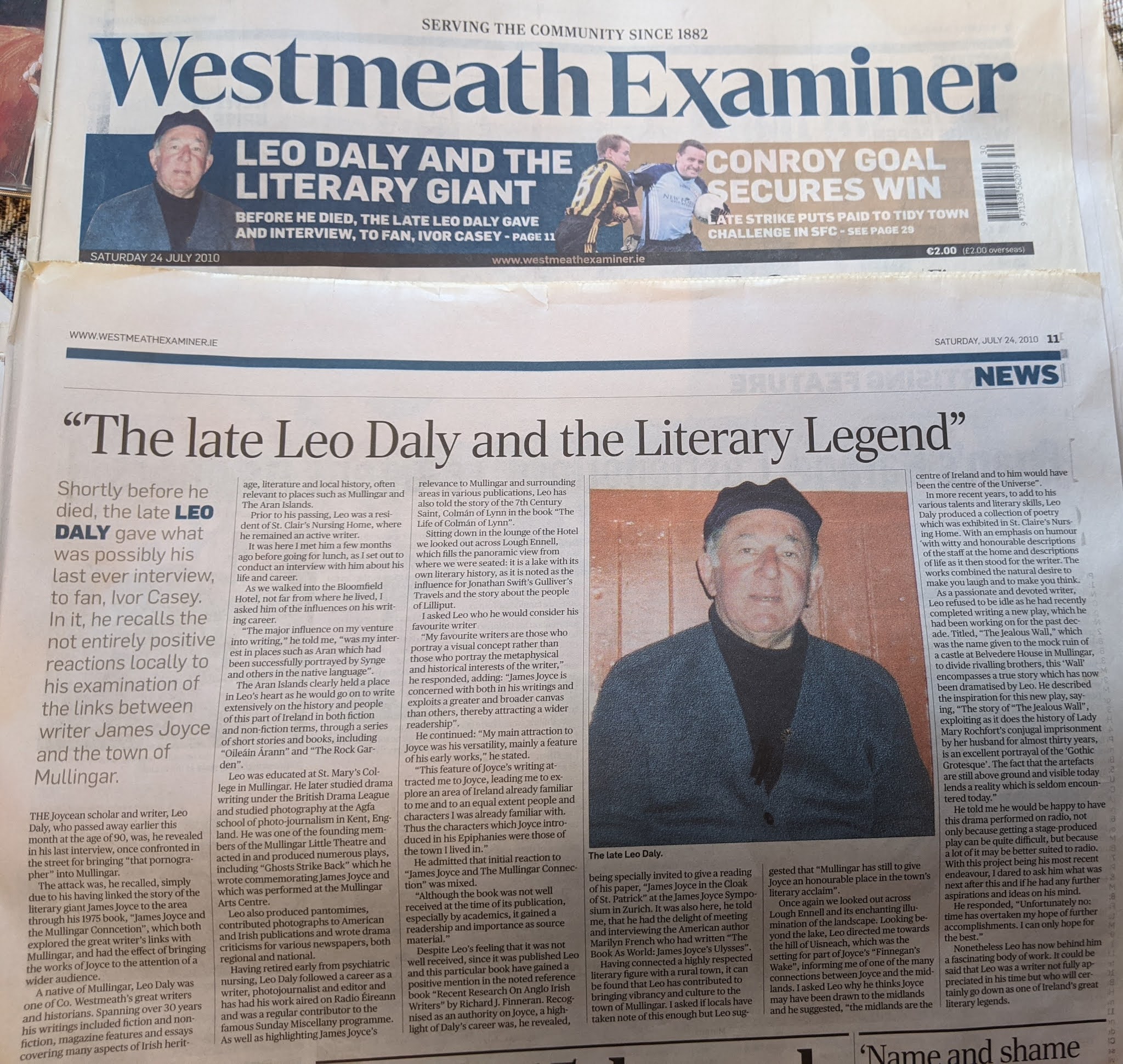
HE was once confronted on the street for bringing ‘that pornographer into Mullingar’. An attack on Joycean scholar and writer Leo Daly, who passed away recently at the age of 90. He had experienced this attack simply for linking the story of the literary giant, James Joyce, to the Westmeath town, through his book, James Joyce and The Mullingar Connection. A book, which printed in 1975, both linked the work of a highly respected literary legend to a small rural town and brought the knowledge and works of Joyce to a wider audience.
A native of Mullingar, Leo Daly is one of Co. Westmeath’s great writers and historians. Spanning over 30 years his writings have included fiction and non-fiction publications, magazine features and essays, covering many aspects of Irish heritage, literature and local history, often relevant to places such as Mullingar and The Aran Islands.
Up until his passing, Leo resided in his home town of Mullingar, a resident of St. Clair’s Nursing Home and remained an active writer. It was here I met him a few months ago before going for lunch, as I set out to conduct an interview with him about his life and career. As we walked into the Bloomfield Hotel, not far from where he lived, I asked him of the influences on his writing career. He told me, ‘the major influence on my venture into writing was my interest in places such as Aran which had been successfully portrayed by Synge and others in the native language’. The Aran Islands clearly held a place in Leo’s heart as he would go on to write extensively on the history and people of this part of Ireland in both fiction and non-fiction terms, through a series of short stories and books, including Oileáin Árann and The Rock Garden.
Leo was educated at St. Marys College in Mullingar. He later studied drama writing under the British drama league and studied photography at the Agfa school of photo-journalism in Kent, England. He was one of the founding members of the Mullingar Little Theatre and has acted in and produced numerous plays, including Ghosts Strike Back which he wrote commemorating James Joyce and was performed at the Mullingar Arts Centre.
Leo has also produced pantomimes, has contributed photographs to American and Irish publications and has written drama criticisms for various newspapers, both regional and national. Having retired early from psychiatric nursing, Leo Daly followed a career as a writer, photojournalist and editor and has had his work aired on Radio Éireann and was a regular contributer to the famous Sunday Miscellany programme. As well as highlighting James Joyce’s relevance to Mullingar and surrounding areas in various publications, Leo has also told the story of the 7th Century Saint, Colmán of Lynn in the book The Life of Colmán of Lynn.
Sitting down in the lounge of the Hotel we looked out across Lough Ennell, which fills the panoramic view from where we were seated. A lake with its own literary history, as it is noted as the influence for Jonathan Swift’s Gullivar’s Travels and the story about the people of Lilliput. I continued to ask Leo who he would consider his favourite writer. Leo explained, ‘my favourite writers are those who portray a visual concept rather than those who portray the metaphysical and historical interests of the writer’. Leo then added, ‘James Joyce is concerned with both in his writings and exploits a greater and broader canvas than others, thereby attracting a wider readership’.
Staying on the area of Joyce I asked of his attraction to Joyce’s work and what the inspiration was to produce such a unique book as James Joyce and The Mullingar Connection. ‘My main attraction to Joyce was his versatility, mainly a feature of his early works’ he stated. Leo continued to explain, ‘This feature of Joyce’s writing attracted me to Joyce, leading me to explore an area of Ireland already familiar to me and to an equal extent people and characters I was already familiar with. Thus the characters which Joyce introduced in his Epiphanies were those of the town I lived in’. In regard to the book itself, I was told, ‘Although the book was not well received at the time of its publication, especially by academics, it gained a readership and importance as source material’.
Despite Leo’s feeling that it was not well received, since it was published Leo and this particular book have gained a positive mention in the noted reference book Recent Research On Anglo Irish Writers by Richard J. Finneran. On asking him what was a highlight of his career, Leo smiled as he thought back to the time he was especially invited to give a reading of his paper, James Joyce in the Cloak of St. Patrick at the James Joyce Symposium in Zurich. It was also here, he told me, that he had the delight to meet and interview the American author Marilyn French who had written, The Book As World: James Joyce’s Ulysses.
Having connected a highly respected literary figure with a rural town, it can be found that Leo has contributed to bringing vibrancy and culture to the town of Mullingar. I asked if locals have taken note of this enough but Leo suggested that ‘Mullingar has still to give Joyce an honourable place in the town’s literary acclaim’. Once again we looked out across Lough Ennell and its enchanting illumination of the landscape. Looking beyond the lake, Leo directed me towards the hill of Uisneach, which was the setting for part of Joyce’s Finnegans Wake, informing me of one of the many connections between Joyce and the midlands. I asked Leo why he thinks Joyce may have been drawn to the midlands and he suggested, ‘the midlands are the centre of Ireland and to him would have been the centre of the Universe’.
In more recent years, to add to his various talents and literary skills Leo Daly has produced a collection of poetry which was exhibited in St. Claire’s Nursing Home. With an emphasis on humour with witty and honourable descriptions of the staff at the home and descriptions of life as it then stood for the writer, his introductory collection of works were funny and insightful. They combined the natural desire to make you laugh and to make you think. Leo only began writing poetry recently and hopefully this work will eventually get a full publication, adding to his great body of literature.
As a passionate and devoted writer, Leo refused to be idle as he had recently completed writing a new play, which he had been working on for the past decade. Titled, The Jealous Wall, which was the name given to the mock ruin of a castle at Belvedere House in Mullingar, to divide rivalling brothers, this ‘Wall’ encompasses a true story which has now been dramatised by Leo. He described the inspiration for this new play, saying, ‘the story of “The Jealous Wall”, exploiting as it does the history of Lady Mary Rochfort’s conjugal imprisonment by her husband for almost thirty years, is an excellent portrayal of the “Gothic Grotesque”. The fact that the artefacts are still above ground and visible today lends a reality which is seldom encountered today’.
He told me he would be happy to have this drama performed on radio, not only because getting a stage produced play can be quite difficult, but because a lot of it may be better suited to radio. With this project being his most recent endeavour, I dared to ask him what was next after this and if he had any further aspirations and ideas on his mind. He responded, ‘Unfortunately no, time has overtaken my hope of further accomplishments. I can only hope for the best’. Nonetheless Leo has now behind him a fascinating body of work. It could be said that Leo is a writer not fully appreciated in his time but who will certainly go down as one of Ireland’s great literary legends.
- Ivor Casey
(Amended from article by Ivor Casey which appeared in 'The Westmeath Examiner' and 'The Sunday Independent')
(Original publication of the final interview with Leo Daly by Ivor Casey, as seen in the The Westmeath Examiner in July, 2010)
(Original publication of 'Obituary of Leo Daly' by Ivor Casey, as seen in the The Sunday Independent in August, 2010)
WHILE the midlands has often become a side stepped region throughout Ireland, its history has included important developments in the name of The Quakers, who spear-headed production in Co. Offaly and Co. Westmeath. It was firstly in Moate, Co. Westmeath where the progression of this community began to flourish and see the earliest advancements in rural Ireland over three and a half centuries ago.
When George Fox founded 'The Society Of Friends' or 'Quakers' over 350 years ago, the Westmeath town of Moate soon became a centre-point for its followers. Fox had set up this new way of life in the wake of the Counter Reformation, having become disillusioned with religious life at the time. He felt churches had become swamped with traditions, rituals and power politics. The main objective of Quakerism was to take care of the poor and provide for widows and the fatherless. It was ensured that all members practised justice, equity and consolation. Quakers were tolerant in allowing people pursue, without criticism, whatever he or she was interested in.
Moate was first introduced to this 'Society Of Friends' in 1658 by a Scottish soldier named William Edmundson, who had already made converts in Co. Antrim. Locals became intrigued by the Quaker lifestyle when Edmundson held a meeting in Ballykilroe and the first 'meeting house' was located at Toorphelim. Followers included John Clibborn who eventually had meetings transferred to his home, Moate Castle, which he came into possession of in 1656. It was the town of Moate where distant visitors, which included Americans, would come to, in search of information about Quakers in Ireland and nearby countries. From here, Quakerism extended to neighbouring counties such as Offaly. With the increasing numbers of friends, local, provincial and national meeting houses were erected in Ireland.
The Midlands Quakers were a most ambitious and productive people, establishing small industries and becoming heavily involved in farming and founded agricultural shows. Some of their factories included woollen and linen mills, brick and tile factories, a tannery and a felt making factory. They were also involved in banking, engineering and shipbuilding as well as producing jams, biscuits and tobacco and the famous Bewleys cafes. A major Quaker run factory was the Goodbody factory in Clara, Co. Offaly which was a flour mill and jute processor.
One particular resourceful Quaker was Dr. Edward Bewley (1806 - 1876), a Medical Doctor and Agriculturist who set up his practice in Moate in 1830. One area he was most keen on was the advancement of farming methods and he became a member of the Agricultural Society of Ireland. He set up a branch of this organisation in Moate which lead to the formation of ploughing matches, farming lectures, an agricultural college and an agricultural show. Dr. Bewley was elected President of the Royal Agricultural Society of Ireland in 1841. His benevolence could be seen during the famine as he was a founding member of the Moate Soup Kitchen. His son Sir Edmund Thomas Bewley (1837 - 1908) was born in Moate and later became a Professor of Law in Trinity College and a Supreme Court Judge.
The Quakers are still very much in existence, with meeting houses all around the country. However, other than one active meeting house in Edenderry in Co. Offaly at present and none in Co. Westmeath, the midlands have lost a symbol of their prosperity. Today, the diminutive remains of a Quaker meeting house can be seen in the grounds of Moate Castle. It was ordered to be demolished in 1921 by the Quaker's 'Dublin Meeting', to avoid misuse when the number of Quakers reduced in the area and the house became empty. There is also the remains of a Quaker graveyard on the same property but this is also gradually disintegrating, despite the best attempts of the local Historical Society to preserve it. With its worsening condition through vandalism and the more natural overgrowth of weeds, briers and nettles, an important attribute of the rural Ireland’s aspirations has been left aside.
While some midlanders today can finally celebrate the progression of sending one of its sons to lead the country, failure has supervened in preserving the memory of a noble people. With Moate Castle having recently been put up for sale, with the Quaker graveyard on the property, there is further uncertainty as to the future of this essential landmark of the Quaker’s memory in Moate.
Nonetheless, it is the legacy of 'The Quakers' which historians continue to bring forward and with the special anniversary year that is now, it is important that tribute is paid to the symbols of ambition and prosperity which once made Moate, and the midlands, a thriving region.
- Ivor Casey
(Amended from an article by Ivor Casey which first appeared in the Westmeath Independent and Ireland's Own)
(Original publication of "Moate's Misplaced Momementous: The Quakers" by Ivor Casey, as seen in the The Westmeath Independent in March, 2008)
ELVIS Presley's career has remained strong for almost 50 years, despite him being dead for over half this time. His long-lasting stance in the business is something no other singer has matched and that has been proven with 'Elvis: The Concert'. Presley was an influence on major Irish musicians. His genealogy can be traced to Ireland. However, he never performed one concert here. In fact, he never performed outside the US, other than a few shows in Canada. That was up until Elvis's estate came up with the next best thing.
The show has played four times in Ireland since 2000, and while the production format has not changed, the spectacular atmosphere remains. 'The Concert' reunites Presley's original 1970s musicians, the TCB Band, to perform live to his recorded voice. Spectators are also able to gaze at several enormous screens with footage of Elvis from 1968 to 1973, singing each of the selected songs. The concept of it being a virtual reality show has generated much suspicion over its quality. Some cynics have laughed at the idea of the main star not being present and it certainly is the estate's latest massive exploitation of its product, who once was a living, breathing and generous man. Despite the commercial aspects of Wednesday's production, the most important area was the music.
The legacy of the show has been mis-interpreted by many people who have not seen it, suggesting that it is like going to the cinema. However, what is essential to point out is that Presley's musicians are extraordinarily talented. While Elvis is the centre of attention, the performers could not be discredited. Other than the previously recorded vocals and footage, this show is every bit of a live concert. From the uplifting blues riff of James Burton on lead guitar to the heart pounding drum beat of Ronnie Tutt, songs of every genre are covered. Also performing are Jerry Scheff on bass guitar and Glen Hardin on piano, while 'The Sweet Inspirations' and 'The Stamps' add in their exquisite harmony.
The audience's response was ecstatic, due to pulse-racing covers of Presley's classic 1950s hits, but the highlights were the superb versions of Suspicious Minds and How Great Thou Art. Admirers get to experience how dramatic Elvis's 1970s concerts were and he was again introduced to a new generation, as the audience age ranged from seven to 70. The 1970s in Presley's life have become infamous for his excessive use of prescribed medication due to gruelling concert schedules and emotional problems, but at the start of this decade there was a phenomenal performer who stunned his audiences. He never failed to convey passion, heart and a deep down love for the music he performed, and that was highlighted in 'Elvis: The Concert'.
- Ivor Casey.
Ivor Casey is currently writing a book on Elvis Presley and Ireland.
(Ammended from article which first appeared in The Sunday Independent, 1 June 2003)