Saturday, December 10, 2011

Westmeath's link to the 1916 Rising by Ivor Casey

Westmeath is not usually considered when it comes to remembering the 1916 Rising but there is certainly one Westmeath man linked to the fight for an independent Ireland who had much involvement. In what is the 30th anniversary of his death, the man I refer to is Tomás Malone. Born in 1896, in Meedin, near Tyrrellspass, Tomás was the son of William and Máire Malone. He was educated at the Franciscan College, Multyfarnham and became qualified in Greek and Irish. However, his family’s deep Republican nature saw him take an interest in the struggle for Independence. In 1912, Liam Mellows, founder member of the Irish volunteers, enrolled him in ‘Na Fianna Éireann’ (The Republican boys movement) and the Malones would become a driving force of Republicanism in Co. Westmeath. 

House of Tomás Malone in Meedin, Tyrrellspass, Co. Westmeath (Photo: Ivor Casey, 2006)


Tomás’ motivation was influenced largely by his mother. She had been a national school teacher, dismissed from her job for teaching children their prayers in Irish. She staged a sit in but was removed by the RIC (Royal Irish Constabulary) and the local Catholic priest. As a result she ended up teaching Irish to children in her home at night. Tomás’ connection with 1916 began when he heard of the events that were transpiring in Dublin. With his brothers, Séamus and Seosamh, and other Irish Volunteers he barricaded his home when police came to carry out a search. The defeat of Irish fighters in Dublin caused Malone to withdraw from his rebellion and he was arrested. Serving a sentence at three different jails including Kilmainham Gaol, he came in contact with other like minded Irish Republicans. After release from prison he was elected to the Army Council of the Volunteers and in 1918 combined this occupation with the native tongue as he began teaching Irish while he travelled the country. Malone was deeply affected by the ideals which inspired the Irish language movement. As well as preserving, arguably, the country’s most important source of identity from Great Britain he used his teaching of the Irish language as a method of recruiting other "freedom fighters". 

Tomás took on the alias of Sean Forde, as he became deeply involved in the Republican movement, arranging and committing ambushes on British forces. He eventually became a Commandant, based in East Limerick and he helped establish the first Flying Column in Ireland. Tomás played a major part in bringing about the surrender of Ballylanders RIC barracks on 27 April 1920. He felt it was ‘the biggest such attack’ undertaken by the column. It lasted several hours, in which two RIC men were killed and eight wounded, while one Republican was killed and two were injured. Tomás also headed the attack on Killmallock barracks, in which it was burned to the ground. His column also succeeded in an attack against military forces at Grange, between Bruff and Limerick City. 

In December 1920, Malone was caught and sent to prison on Spike Island off the Cork coast, but the prison authorities were not aware that they were detaining such a notorious Republican on the island. Although a fellow prisoner let slip who Malone was, the British needed a formal identification of the Republican and sent for someone who could pinpoint the IRA man. Nonetheless, their only source of uncovering the truth was executed by the IRA before he reached the island. In the meantime, General Liam Lynch, of the Cork No.2 Brigade, became aware of the circumstances. Lynch sent Malone a message stating, ‘we will get you out of there - it will only be a matter of time before they identify you’. The Cork Brigade HQ instructed that a plan of escape be organised from the island. The three men to be rescued were Tomás Malone, Sean Twomey and Sean MacSwiney, the brother of the martyred Cork Lord Mayor, Terence. On 29 April 1921, Tomás Malone and the two fellow prisoners, were outside working on the prison grounds when they overpowered the guards and achieved a victorious and dramatic escape as an IRA boat, marked with a union jack, awaited them in the harbour. 

At a later point, Tomás took the anti-treaty side and was again put in prison, now at Portlaoise, then known as Marysborough Jail. Here Michael Collins visited him requesting he use his influence to bring an end to the Civil War. Collins suggested a peace meeting between Malone and Commanding Cork born Republicans, Tom Hales and Tom Barry. This was one of the last movements of Collins as he was soon assassinated on 22 August 1922. Portlaoise prison was burned down by prisoners and Malone was transferred to the Curragh where, in 1923, he made his last ever prison break, hiding in a cart that was removing kitchen waste. By now Independence had been declared and in 1925 he took a job as a school teacher in Nenagh, Co. Tipperary, eventually becoming Principal. Nenagh would remain his home until his death in 1981. Although Tomás Malone was a man whose adventures to overthrow Crown forces brought him to various spots around Ireland, he will always be a Westmeath man. Tomás Malone's attempts to rebel against Britain in 1916 marked Westmeath as the only county between Dublin and Galway where bullets were fired in the attempt for Ireland to become an independent nation. 

- Ivor Casey 

(Amended from an article by Ivor Casey previously printed in The Wesmeath Independent, The Westmeath Examiner and Ireland's Own)

Original publication of 'Westmeath's link to the 1916 Rising' by Ivor Casey, as seen in the The Westmeath Independent in 2006

Friday, September 2, 2011

Che Guevara: The anti-Gay "icon"? by Ivor Casey

He is called a revolutionary. He is a cherished hero to some, a simple face in an iconic photograph to others. His image is used by fashion designers for marketable kitsch, which ironically goes against the politics he stood for. His legacy is used as a symbolic force for political goals but is also used by a certain section of hardcore socialists as propaganda to manipulate angry young people. Turn a corner on any city street in Ireland and his image dons the face of a t-shirt, usually worn by somebody convinced it highlights their liberalism. However, Che Guevara, the man worshipped for fighting the capitalist system to try and instil a fairer and more generous left-wing socialist system, also helped instil a system that could be considered to be an embodiment of far right-wing styled bigotry, when it came to human rights and most notably gay rights. For decades this side of his and the Cuban revolution's history has been misinterpreted and misunderstood by mostly misguided anarchists who seem to turn a blind eye to the safety of minority groups.

The initial and watered down rhetoric of Guevara’s story, carefully chosen by his supporters is one which revolves around a young man from Argentina, who on his travels in Latin America witnessed the extreme poverty and starvation of one section of society while the other side basked in great wealth and riches. From here the story escalates into a narrative of a man trying to dismantle the capitalist structures which can be argued to cause such economic inequality. His story tells of a guerrilla fighter who subsequently constructed a socialist regime. He set out on adventures to overthrow American supported leaders in Cuba, was supported by insurgents and became a key figure of the Cuban revolution, working with Fidel Castro under a new government. His ethic of fighting and supporting class struggle is one to be easily admired and one which I, as somebody who is highly supportive of a redistribution of wealth, commend. However, regarding the 1960's Cuban revolutionaries specifically, this take is unfortunately used as a knee jerk reaction for reverence and glorification.

Under the new Cuban revolution, a revolution which was supposed to be about bringing about socialist principles of a classless society and true equality, various groups of vulnerable people were singled out for persecution. Having fought their way into power the Cuban revolutionaries lead an abuse of power excluding and banning what they desired even if it had nothing directly to do with their specific cause of a classless society. This notably included, among all things rock ‘n’ roll music and homosexuality.This thinking immediately aligns them with the conservatives in America who also opposed these things. However, unlike the American conservatives, Guevara and his associates had past leaders within their political spectrum whom to learn from such as Vladimir Lenin, whose new acts in 1922 decriminalised homosexuality. This had been a daring move, later overturned by Stalin.

Although there are apparently no glaringly obvious quotes to highlight any hardcore homophobia on the part of Che Guevara, he does allude to a disgust of homosexuality in his memoirs, where upon speaking about a particular individual he notes "the episode upset us a little because the poor man, apart from being homosexual and a first rate bore, had been very nice to to us...". Highlighting the man's sexuality as a point of negative criticism may appear mild to some, but for a man of this power and persuasion, his comment projects a homophobic thinking.

Under the Cuban revolution, the system fought for by Guevara and his associates, established ‘labour camps’, known as the UMAP labour camps, to incarcerate gay people, among other groups, which mostly included people of a religious background. These were Cuba's new concentration camps, set up so the new socialist government could rid their nation of homosexuality, which was somehow believed to be a product of capitalism. Gay artists were censored and gay people in government lost their jobs. The UMAP camps subjected homosexuals to brutal torture and some inmates committed suicide. Not only gay men were incarcerated but effeminate men were also imprisoned. People who did not fit into the fascist vision of masculinity were imprisoned without charge or trial and forced to adhere to the notion of masculinity through slave labour.

In these camps gay men who had been rounded up were subjected to rehabilitation and re-education. An argument that “the times” were different is nullified by Lenin's 1922 acts, and the fact that the revolution was setting out to change “the times” but whatever it did, gave no thought or consideration to minorities. If socialism, as revolutionaries in Cuba saw it, was supposed to be this greater, fairer advancement on capitalism and human rights, where was the advancement for homosexuals? It appears the price paid for an improved social welfare system was the freedom of a minority. A claim that Guevara was not in Cuba during the existence of these camps, therefore excusing him, is irrelevant as it didn't take him to physically be around for the ideology to be enforced. The fact that he had enormous power over the way Cuba operated, implicates him as an important part of this brutal treatment. Under no circumstances is it or was it ever acceptable to persecute people based on their sexuality, not now and not then, especially when the whole point of the revolution was only to end an aggressive and greedy capitalist and right-wing system. 

While the pre-revolution Cuba was no safe haven for gay people, the man who would go on to be so revered for being a revolutionary was incapable of going the distance with a fight for human rights. It was not until after Guevara was killed in 1967 that these camps were closed by Castro when he witnessed first hand the harsh conditions, as well as their negative attention worldwide. Nonetheless, homosexuality was not decriminalised in Cuba until 1979.

By the 1980's some homophobic attitudes were relaxed including the Ministry of Culture stating that homophobic bigotry was unacceptable. Castro has even expressed regret for the treatment of gay people during the earlier period of the revolution. Nonetheless, in the fifty years since, there has been very little revolutionary practice on behalf of human or civil rights for gay people. Gay clubs and organisations are banned and as of 2011, gay people are not allowed either marriage or civil partnership and there are no laws prohibiting 'hate speech'. For all the differences claimed and fought for between socialism and capitalism, one thing is for certain and that is that gay rights seem to be insignificant, even within the system that parades itself on being egalitarian and revolutionary. Che Guevara may have revolted against corrupt capitalists, making him an admirable and iconic symbol of social change. Nevertheless, while mostly young people succumb to the promotion of a false hero, with regard to all round human rights, and don the face of who they think was some noble warrior (or a rock star), it must be remembered that the UMAP camps were stringently homophobic and a serious part of what his revolution instilled. On the other hand, an entire section of the consumer market may have no idea who this face belongs to, accepting it as some random mass market pop culture figure, something Guevara himself scorned.


- Ivor Casey


Bibliography:

  • Bejel, Emilio. Gay Cuban Nation (University of Chicago Press, 2001)
  • Dore, Elizabeth & Carrie Hamilton. Sexual Revolutions in Cuba: Passion, Politics and Memory (Envisioning Cuba) (The University of North Carolina Press, 2012)
  • Goldman, Dave E. Out of Bounds: Islands and the Demarcation of Identity in the Hispanic Caribbean (Bucknell Studies in Latin American Literature and Theory), (Bucknell University Press, 2008)
  • Guevara, Ernesto. The Motorcycle Diaries (Ocean Press, 2003)
  • Improper Conduct, (Dirs. Néstor Almendros & Orlando Jiménez Leal, 1984)
  • Lumsden, Ian. Machos, Maricones and Gays: Cuba and Homosexuality (Temple University Press, 1996)
  • Tatchell, Peter. 'Gay Rights and Wrongs in Cuba', http://www.pinktriangle.org.uk/glh/213/cuba.html

Wednesday, May 25, 2011

Becoming a Stronger Individual by Ivor Casey

ONE of my deepest felt philosophies in which I'll always adhere to is to remember those friends who were there for you during your darkest hours and just walk away from those who appeared to be giving on one hand, but taking with the other. What this ultimately means is to, without complete devotion, simply never forget the people who expressed concern for you without any manipulation to get something in return, whether it was some superficial desire to pry into your private life for personal satisfaction or to rally support for a clique in which a hierarchy exists. What needs to be done to find a better sense of who you are is to not fall subservient to these groups. 

In times of doubt and anxiety always be careful not to trust too many people who claim to be your friend, as some will take advantage of your vulnerability. Avoid the cliques in times of sorrow as they will chew you to bits by delving into this vulnerability and extracting the information they want to toss about as gossip. Always keep in mind the individuals who were there on a personal and considerate level and who, no matter how many times you might have repeated yourself, still stood by and kept you strong as you found your path. Just walk away from those who have used your depression or personal issues for gossip and never be intimidated into believing you need a clique. Through sensitivity, depression and vulnerability people often collapse into cliques, which only prove to be a false sense of security.

When you are still maturing, finding your own sense of identity and finding your sense of place in the world it is very easy to get caught in a clique out of peer pressure and societal expectations. Those with depression and anxiety issues often sustain a deep sensitivity where they will lose a lot of self respect and self esteem. Maturity has no age limits. Maturity will only become more prevalent the more a person strengthens their confidence and the more they find their place in the world. This can manifest itself by finding other "individuals" and finally somebody who genuinely loves you. Cliques by their very nature exist to keep people thinking the same thoughts, to keep the same frame of mind and strengthen an insular world without room for growth, diversity or change. As a team, their power over others can strip the more impressionable members of original thought and individuality, by pushing ideologies and belittling individuals who have different ideas.

It can be difficult to remove yourself from this but the pressures of a clique will only have a damaging and negative impact. Those in cliques have political agendas and their foremost personalities are not of an artistic, sensitive or emotionally intelligent nature. They want everybody to stay the same to push the ideology of the hierarchy. However, human beings are not mere pawns, we are individuals who can survive with other individuals, not groups of random faces. Always remember to be an individual, for it is by being an individual you will discover who you are and not what is expected of you.

If you are ever being bullied, threatened or intimidated, don't think you are the problem for being bothered by it and don't let any assumed superiority tell you otherwise. Don't let anybody who has not shared your experiences tell you how you are to live your life. Remember that nobody has any idea what is going on in the life of another person and there is no justification to judge. Just walk away from the people who are a negative force in your life as you do not need them. And never let the cliques manipulate you into thinking you have done something wrong by "deserting". The cliques have each other but as an individual you need to save yourself. Invest your energy in those with whom you can bond to make life somewhat more productive, cheerful and positive.

Saturday, April 2, 2011

Remembering the Seductive Soul of Barry White by Ivor Casey

IT has been 50 years since a petty thief suddenly decided to change his ways after listenting to Elvis Presley sing "It's Now or Never" while in prison. This thief would go on to become one of the most cherished love singers of all time. His voice has often been compared to the feeling of melting caramel. A description of the lustful, lascivious and libidinous sounds of Barry White who became known as ‘the Guru of love’ for his lush bass and velvet voice. A silky smooth, sultry voice highlighted in such sexually charged songs as “Can’t Get Enough Of Your Love Babe” and “Just The Way You Are”. Sexually flavoured and deliciously romantic numbers, which instinctively set the scene for dimmed lights, candles, slow undressing and body contact.

Born into a humble environment on 12 September 1944, in Galveston, Texas, Barry moved to Los Angeles where he spent the rest of his childhood with his brother and single mother. White explained that he was shocked by his unusually deep vocals, which emerged over night when he was still a teenager. From a young age he discovered an enthusiasm for music and began performing with a Baptist choir. However, as a teenager his musical interests took a back-seat to his life in petty crime and in 1961 he was sentenced to five months in prison for stealing tyres.

It was while in prison that Barry was once again inspired by the allure of music when he heard Elvis sing. The song was a calling and reached out to young Barry who suddenly realised that it was time for him to do something special with his life. Throughout the 1960’s White tried desperately to succeed in the music business and began writing love songs. He became a record producer for the group “Love Unlimited” but discovered the talent to sing his own songs with his mellifluous voice, which lead to his first solo hit in 1973, “I’m Gonna Love You Just A Little More Babe”.

It was his butter smooth vocals which helped create the sensual charisma in his stimulating love songs “Let The Music Play” and “You’re The First, The Last, My Everything”. The soulful, suggestive and sensuous performer sold over 100 million records and had a career that spread further than three decades. He became a master of 1970’s disco and funk with the hits, “Love’s Theme” and “Never Gonna Give You Up” and his effortless but distinctive talent mesmerised millions of lovers across the world. It has been claimed the orgiastic sensations of his music helped influence the baby boom of the 1970s across America. His music’s overtly sexual connotations were extremely high pitched as the tantalising, thrusting and throbbing erotic power in both the lyrics and his vocals created a salacious, sensual and steamy sensation. Songs such as “It’s All About Love” and “Oh Me, Oh My, I’m Such A Lucky Guy”, with the deep breathing and gentle groans of satisfaction, were highly representative of passionate sexual intercourse in the most romantic, virtuous and celestial ways.

Barry’s career took a downfall in the 1980’s and his attempts at staging a comeback failed until his 1994 album release of “The Icon Is Love”, which became his next great hit. He enjoyed a return to concert performances and the charts throughout the 1990’s and appeared on the TV shows The Simpsons and Ally McBeal and performed a duet with Luciano Pavarotti. Unfortunately, too much touring took its toll and he was hospitalised several times for exhaustion. His health began to decline and he had severely high blood pressure. Between September 2002 and May 2003 he suffered from kidney failure and suffered a stroke which affected his voice and the left side of his body. He had been undergoing dialysis treatment and was awaiting a kidney transplant when he suddenly died at Cedars-Sinai medical centre in Los Angeles on 4 July 2003.

Barry White produced a genuine understanding of sensorial music by being a natural, instinctive and suave performer. His recordings have enjoyed great success to this day and while testosterone levels remain rampant and consenting couples with high sex drives desire seductive songs, he will continue to be a tremendous and timeless talent, never to be forgotten for those provocative, permeating and penetrating sounds.

- Ivor Casey


Saturday, January 22, 2011

The Return of TV's Super-soap Dallas! by Ivor Casey

Today it may seem like one of those old shows deliberately avoiding an integral examination of society and class or the subordinate. However when the oil-baron super-soap Dallas first hit TV screens over 30 years ago it did manage to break down barriers for popular culture, besides bringing its audience into unequalled escapist fantasy. Now almost twenty years since it last aired, it has been announced that a new series of Dallas, focusing primarily on the next generation of characters, is in the pipeline. Once again, TV viewers confined to their homes due to the recession, just like in the 1980s, will be brought into a surreal world of glamour and absurd yet delicious drama and plot lines. 

In Spring of 1978, a five episode pilot was screened and after proving popular the first season was commissioned to begin in September. Lasting 13 years Dallas became the most successful television series of all time, gaining over 350 million viewers world-wide. Its plots and success made news headlines and it became one of the most talked about entertainment sources for a decade. Especially with the “Who Shot JR?” plot which set the trend for all TV cliff-hangers since.

It is now seen as the foremost example for academic critique of American cultural imperialism and hegemony, with its original series referred to as 'a cheap TV show dumped on developing countries'. Nevertheless Dallas did and still does manage to help people put aside their troubles for an hour and see the fun side of extreme wealth, or maybe even the actually unglamorous side as the wealthy constantly appeared to be up against some troubling experience after another. Nothing like it had ever been on television before and never had a weekly series been an event. Revolving around the feuding Ewing and Barnes families Dallas incorporated everything desired for a passive entertainment TV show, with greed, power, murder and deceit. It was clearly politically incorrect and it certainly favoured chauvinism, but it managed to break some social barriers, even if it didn’t use the platform it held for many positive and constructive reasons. In Ireland conventional parents and priests ridiculed its content as blasphemous for its high pitched sexual innuendo, too liberal for TV. However, its massive popularity here conveyed an ever changing Ireland. Its main reason for such hype and controversy was the sexually rampant and shrewd businessman, JR Ewing, played by Larry Hagman, who is reported to be reprising his role in the upcoming series. It was JR and his company, Ewing Oil, that became the centre focus for the show as it emphasised how successful businesses can achieve. With ferocious greed, back-stabbing, ruthlessness, walking over your own mother to get ahead, the show detailed key ingredients of corporate success. JR was a corrupt, evil and manipulative womaniser but this made his character all the more appealing.

It could be found that an ideology representing capitalism and self made millionaires, glorifying the so called ‘American Dream’, suggested to the viewers around the world that you could have whatever you wanted, once you worked hard for it under a Capitalist system. Dallas was followed by similar dramas such as Falcon Crest and Dynasty which followed a parallel pattern. With regard to social themes, while Dallas stayed away from racism it failed to ever include a main character of any minority group or race other than Anglo - Caucasian men and women. The main characters were the apotheosis of the white, heterosexual, western male. It can be argued that the series was mainly about the oil business but that it also managed to cover topics not common in TV dramas prior to this and included stories, if only ever briefly, involving homosexuality, affairs, mis-carriages, ill-health, down syndrome, divorce and extra-marital sex. A two hour episode in 1980 dedicated a story to the matriarch of the drama, Miss Ellie, played by Barbra Bel Geddes, being diagnosed with breast cancer and having to undergo a mastectomy. However, possibly the most ever current of social issues raised in the series was the alcoholism of JR Ewing’s neglected wife, Sue Ellen, played by Linda Gray. One particular plot line, which highlighted the effects of alcoholism at its very worst, showing its victims on the brink of death, helped raise the show above the candy floss delights of wealth and power. Sue Ellen was frequently shown as the down trodden and unfortunate wife of an evil man.

Nothing has replaced Dallas with its original and classy technique of mixing glamour and wealth with tension and grandiose suspense. Although most soaps are cheap and fatuous, with low production values, Dallas was shot like a movie. Dallas was expensive, hard-hitting and intriguing entertainment, with very little as equally stylish made since. What remains to be seen is if the new series will live up to the original, which has found a whole new generation of fans due to its regular repeats across TV and the successful sales of all its seasons on DVD. Besides Larry Hagman, the new Dallas is reported to have Patrick Duffy on board as Bobby, as well a possible return for Linda Gray as Sue Ellen. The show will also star Josh Henderson and Jesse Metcalfe taking the reins of the new generation. It will begin filming closer to summer with a screening in Summer 2012.

- Ivor Casey

Monday, December 6, 2010

Silver Screen Sci-Fi by Ivor Casey


SILVER SCREEN SCIENCE (By Ivor Casey)

Sci – fi is a genre which covers futuristic speculation
Sci – fi is a style with fictional techno celebration
It is enjoyed through books, comics, art and games
But it’s the movies which help light its brightest flames

Time travel is presented with photos in La Jetee (1962)
Time fast forwards suddenly in 2001: A Space Odyssey (1968)
A journey to fulfilment of desires is the basis of Stalker (1979)
Intergalactic battles form the adventures of Luke Skywalker

Old folks find youth with strange objects, in Cocoon (1985)
Amazon adventures meet the Creature from the Black Lagoon (1954)
Sci-fi shows us a face transplant in Eyes Without a Face (1960)
And a talking feline in Disney’s Cat From Outer Space (1978)

There are pessimistic predictions of a future city in Metropolis (1927)
Alien intelligence up to no good on distant planets in Solyaris (1972)
Bureaucrats and administrative errors in Terry Gilliam’s Brazil (1985)
There are futuristic cities on other planets as in Alphaville (1965)

Sci-fi is a form of fiction which delves into the depths of imagination
Sci-fi can be defined as exaggerated reality or structural fabulation
A corporate controlled, violent future is represented in Rollerball (1975)
Cover ups, memory implants, an adventure on Mars in Total Recall (1990)

A cyborg killer as played by Arnie in The Terminator (1984)
Dead tissue used for bizarre experiments in Re-Animator (1985)
Horror makes its way in with the surreal Eraserhead (1977)
And flesh eating zombies in Night Of The Living Dead (1968)

There’s modern greats like Eternal Sunshine of the Spotless Mind (2004)
Or Steven Spielberg’s E.T. (1982) and Close Encounters of The Third Kind (1977)
A fantastical land where dinosaurs still roam in The Land That Time Forgot (1975)
All time classics like Blade Runner (1982) and Alien (1979) from director Ridley Scott

Sci – fi is built upon an expansion of scientific knowledge ascertained
Sci – fi is an incredible genre used in the movies to keep us entertained.


Copyright - Ivor Casey


Sunday, November 21, 2010

Elvis is dead, Long Live The King by Ivor Casey

FOR me, aged 13 in 1997, discovering Elvis Presley was like being introduced to a whole new world: a world away from image victimisation and frivolous performers. It was the discovery that music once meant something and there was a time when singers with heart and soul were the most successful in the business. Being a modern day teenager in a society that's intolerant of individualism made it tough to be a fan of a dead singer. While this did distance me from some, Presley's rise educated me about having passion for what one truly believes in and his downfall made me aware of the emotionally strenuous aspects of life.

A chance encounter with the flood of TV tributes on the 20th anniversary of his death engrossed me like nothing had ever done before. His song Always On My Mind was a major hit in Ireland at the time and it was the song's meaning that drew me to Presley. Through it, I was first introduced to the poignant story of Elvis's later years. That song described a man regretting how he had ruined a relationship. It was recorded after Presley's divorce in 1972 and subsequently his life began to spiral downhill until his untimely death in 1977. Singing songs of solitude and despondency to the end, he related his own pathos in the music.

While many are aware of how he contributed to his own decline, it is harder to comprehend why he couldn't help himself. I wanted to understand why a man with such talent and success became so self destructive. Presley was the world's first superstar and he had nobody to take guidance from. Others can now learn from Presley's mistakes but he took the bashing as he made the first moves. Unfortunately, nobody can save their own life once they have lost faith in living. Being a compassionate and sensitive man, suffering from depression and having achieved everything one man can comprehend, Elvis really didn't have too much more to reach for. And some of his goals and ambitions could not be achieved because of the mysterious control his manager had over him. There is the image of the "drug abuser" or, more truthfully, Presley's biological addiction to prescription medicine: in today's world, he would be seen as a victim rather than an abuser.

Presley was a massive phenomenon and it took me time to realise the unique abilities behind his superior singing voice. Emotionally void art snobs bemoaned the fact that he didn't write songs, but I set out to discover something more important than the ability to write lyrics. I discovered that from the time Elvis made his first recording in the summer of 1953, he used natural empathy to bring out the meaning in a song. Elvis embodied the most important human characteristic: feeling. His method of interpreting a song was inspirational. That was the genius of Presley. As our own Irish legend Bono stated, "Elvis had the wisdom that makes wise men look foolish".

Some people have the impertinence to compare this timeless icon to today's fabricated pop stars. No pop stars will ever last over 50 years or equal his charisma, vocal range and the fact he founded a musical style that changed world cultures. Some claim he stole black music but I dare those to challenge the accurate belief of soul god James Brown, who explained, "Elvis wasn't copying. He found his own style".

Later, Elvis did lose touch with his roots but his raw energetic presence is still available to be heard. His is the story of a man who used fortitude to break down the barriers of racist and conservative societies. Once you look past all the unsavoury stereotypes, Elvis Presley was a regular man who was gifted enough to make a teenager from an entirely different generation realise the meaning of music and how it is an essential part of life.

- Ivor Casey

(Ammended from article by Ivor Casey first published in 'The Sunday Independent', 17 August, 2003)

Wednesday, November 3, 2010

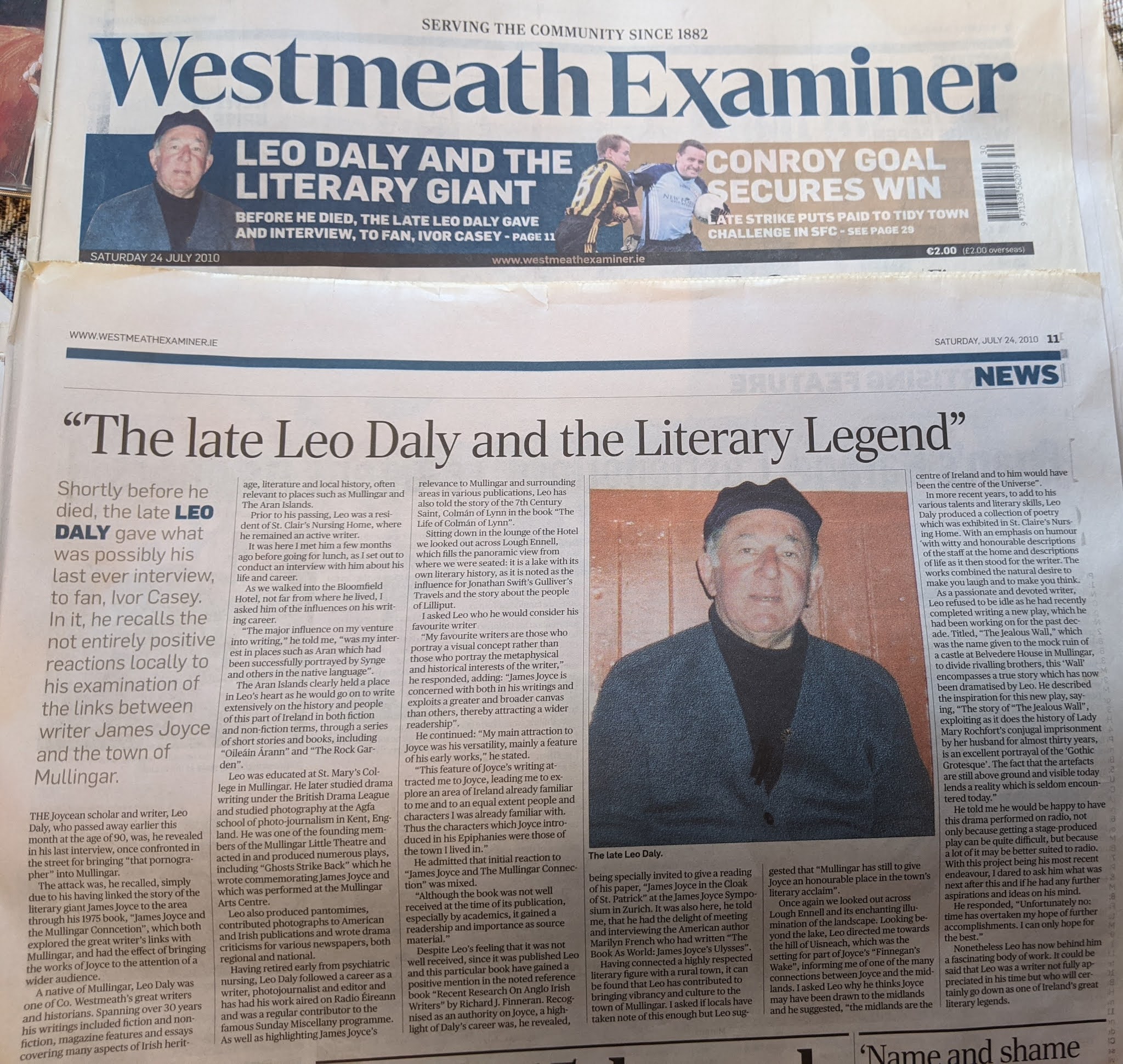
Leo and the Literary Legend by Ivor Casey


HE was once confronted on the street for bringing ‘that pornographer into Mullingar’. An attack on Joycean scholar and writer Leo Daly, who passed away recently at the age of 90.  He had experienced this attack simply for linking the story of the literary giant, James Joyce, to the Westmeath town, through his book, James Joyce and The Mullingar Connection. A book, which printed in 1975, both linked the work of a highly respected literary legend to a small rural town and brought the knowledge and works of Joyce to a wider audience.

A native of Mullingar, Leo Daly is one of Co. Westmeath’s great writers and historians. Spanning over 30 years his writings have included fiction and non-fiction publications, magazine features and essays, covering many aspects of Irish heritage, literature and local history, often relevant to places such as Mullingar and The Aran Islands.

Up until his passing, Leo resided in his home town of Mullingar, a resident of St. Clair’s Nursing Home and remained an active writer. It was here I met him a few months ago before going for lunch, as I set out to conduct an interview with him about his life and career. As we walked into the Bloomfield Hotel, not far from where he lived, I asked him of the influences on his writing career. He told me, ‘the major influence on my venture into writing was my interest in places such as Aran which had been successfully portrayed by Synge and others in the native language’. The Aran Islands clearly held a place in Leo’s heart as he would go on to write extensively on the history and people of this part of Ireland in both fiction and non-fiction terms, through a series of short stories and books, including Oileáin Árann and The Rock Garden.

Leo was educated at St. Marys College in Mullingar. He later studied drama writing under the British drama league and studied photography at the Agfa school of photo-journalism in Kent, England. He was one of the founding members of the Mullingar Little Theatre and has acted in and produced numerous plays, including Ghosts Strike Back which he wrote commemorating James Joyce and was performed at the Mullingar Arts Centre.

Leo has also produced pantomimes, has contributed photographs to American and Irish publications and has written drama criticisms for various newspapers, both regional and national. Having retired early from psychiatric nursing, Leo Daly followed a career as a writer, photojournalist and editor and has had his work aired on Radio Éireann and was a regular contributer to the famous Sunday Miscellany programme. As well as highlighting James Joyce’s relevance to Mullingar and surrounding areas in various publications, Leo has also told the story of the 7th Century Saint, Colmán of Lynn in the book The Life of  Colmán of Lynn.

Sitting down in the lounge of the Hotel we looked out across Lough Ennell, which fills the panoramic view from where we were seated. A lake with its own literary history, as it is noted as the influence for Jonathan Swift’s Gullivar’s Travels and the story about the people of Lilliput. I continued to ask Leo who he would consider his favourite writer. Leo explained, ‘my favourite writers are those who portray a visual concept rather than those who portray the metaphysical and historical interests of the writer’. Leo then added, ‘James Joyce is concerned with both in his writings and exploits a greater and broader canvas than others, thereby attracting a wider readership’.

Staying on the area of Joyce I asked of his attraction to Joyce’s work and what the inspiration was to produce such a unique book as James Joyce and The Mullingar Connection. ‘My main attraction to Joyce was his versatility, mainly a feature of his early works’ he stated. Leo continued to explain, ‘This feature of Joyce’s writing attracted me to Joyce, leading me to explore an area of Ireland already familiar to me and to an equal extent people and characters I was already familiar with. Thus the characters which Joyce introduced in his Epiphanies were those of the town I lived in’. In regard to the book itself, I was told, ‘Although the book was not well received at the time of its publication, especially by academics, it gained a readership and importance as source material’.

Despite Leo’s feeling that it was not well received, since it was published Leo and this particular book have gained a positive mention in the noted reference book Recent Research On Anglo Irish Writers by Richard J. Finneran. On asking him what was a highlight of his career, Leo smiled as he thought back to the time he was especially invited to give a reading of his paper, James Joyce in the Cloak of St. Patrick at the James Joyce Symposium in Zurich. It was also here, he told me, that he had the delight to meet and interview the American author Marilyn French who had written, The Book As World: James Joyce’s Ulysses.

Having connected a highly respected literary figure with a rural town, it can be found that Leo has contributed to bringing vibrancy and culture to the town of Mullingar. I asked if locals have taken note of this enough but Leo suggested that ‘Mullingar has still to give Joyce an honourable place in the town’s literary acclaim’. Once again we looked out across Lough Ennell and its enchanting illumination of the landscape. Looking beyond the lake, Leo directed me towards the hill of Uisneach, which was the setting for part of Joyce’s Finnegans Wake, informing me of one of the many connections between Joyce and the midlands. I asked Leo why he thinks Joyce may have been drawn to the midlands and he suggested, ‘the midlands are the centre of Ireland and to him would have been the centre of the Universe’.

In more recent years, to add to his various talents and literary skills Leo Daly has produced a collection of poetry which was exhibited in St. Claire’s Nursing Home. With an emphasis on humour with witty and honourable descriptions of the staff at the home and descriptions of life as it then stood for the writer, his introductory collection of works were funny and insightful. They combined the natural desire to make you laugh and to make you think. Leo only began writing poetry recently and hopefully this work will eventually get a full publication, adding to his great body of literature.

As a passionate and devoted writer, Leo refused to be idle as he had recently completed writing a new play, which he had been working on for the past decade. Titled, The Jealous Wall, which was the name given to the mock ruin of a castle at Belvedere House in Mullingar, to divide rivalling brothers, this ‘Wall’ encompasses a true story which has now been dramatised by Leo. He described the inspiration for this new play, saying, ‘the story of “The Jealous Wall”, exploiting as it does the history of Lady Mary Rochfort’s conjugal imprisonment by her husband for almost thirty years, is an excellent portrayal of the “Gothic Grotesque”. The fact that the artefacts are still above ground and visible today lends a reality which is seldom encountered today’.

He told me he would be happy to have this drama performed on radio, not only because getting a stage produced play can be quite difficult, but because a lot of it may be better suited to radio. With this project being his most recent endeavour, I dared to ask him what was next after this and if he had any further aspirations and ideas on his mind. He responded, ‘Unfortunately no, time has overtaken my hope of further accomplishments. I can only hope for the best’. Nonetheless Leo has now behind him a fascinating body of work. It could be said that Leo is a writer not fully appreciated in his time but who will certainly go down as one of Ireland’s great literary legends.

- Ivor Casey

(Amended from article by Ivor Casey  which appeared in 'The Westmeath Examiner' and 'The Sunday Independent')


(Original publication of  the final interview with Leo Daly by Ivor Casey, as seen in the The Westmeath Examiner
 in July, 2010)


(Original publication of 'Obituary of Leo Daly' by Ivor Casey, as seen in the The Sunday Independent in August, 2010)


Sunday, October 31, 2010

The Midland's Misplaced Momentous: The Quakers by Ivor Casey

WHILE the  midlands  has  often  become  a  side stepped  region  throughout  Ireland,  its  history  has  included  important  developments  in  the  name  of  The  Quakers,  who  spear-headed  production  in  Co. Offaly  and  Co. Westmeath.  It   was  firstly  in  Moate,  Co. Westmeath  where  the  progression  of  this  community  began  to  flourish  and  see  the  earliest  advancements  in  rural  Ireland  over  three  and  a  half  centuries  ago.

When  George  Fox  founded  'The  Society  Of  Friends'  or  'Quakers'  over  350 years ago,  the  Westmeath  town  of  Moate  soon  became  a  centre-point  for  its  followers.  Fox  had  set  up  this  new  way  of  life  in  the  wake  of  the  Counter  Reformation,  having  become  disillusioned  with  religious  life  at  the  time.  He  felt  churches  had  become  swamped  with  traditions,  rituals  and  power  politics.  The  main  objective  of  Quakerism  was  to  take  care  of  the  poor  and  provide  for  widows  and  the  fatherless.  It  was  ensured  that  all  members  practised  justice,  equity  and  consolation.  Quakers  were  tolerant  in  allowing  people  pursue,  without  criticism,  whatever  he  or  she  was  interested  in.


Moate Castle, Moate, Co. Westmeath (Photo: Ivor Casey)
Moate  was  first  introduced  to  this  'Society  Of  Friends'  in  1658  by  a  Scottish  soldier  named  William  Edmundson,  who  had  already  made  converts  in  Co.  Antrim.  Locals  became  intrigued  by  the  Quaker  lifestyle  when  Edmundson  held  a  meeting  in  Ballykilroe  and  the  first  'meeting  house'  was  located  at  Toorphelim.  Followers  included  John  Clibborn  who  eventually  had  meetings  transferred  to  his  home,  Moate  Castle,  which  he  came  into  possession  of  in  1656.  It  was  the  town  of  Moate  where  distant  visitors,  which  included  Americans,  would  come  to,  in  search  of  information  about  Quakers  in  Ireland  and  nearby  countries.  From  here,  Quakerism  extended  to  neighbouring  counties  such  as  Offaly.  With  the  increasing  numbers  of  friends,  local,  provincial  and  national  meeting  houses  were  erected  in  Ireland.

The  Midlands  Quakers  were  a  most  ambitious  and  productive  people,  establishing  small  industries  and  becoming  heavily  involved  in  farming  and  founded  agricultural  shows.  Some  of  their  factories  included  woollen  and  linen  mills,  brick  and  tile  factories, a  tannery  and  a  felt  making  factory.  They  were  also  involved  in  banking,  engineering  and  shipbuilding  as  well  as  producing  jams,  biscuits  and  tobacco  and  the  famous Bewleys  cafes.  A  major  Quaker  run  factory  was  the  Goodbody  factory  in  Clara,  Co. Offaly  which  was  a  flour  mill  and  jute  processor.

One  particular  resourceful  Quaker  was  Dr.  Edward  Bewley  (1806 - 1876),  a  Medical  Doctor  and  Agriculturist  who  set  up  his  practice  in  Moate  in  1830.  One  area  he  was  most  keen  on  was  the  advancement  of  farming  methods  and  he  became  a  member  of  the  Agricultural  Society  of  Ireland.  He  set  up  a  branch  of  this  organisation  in  Moate  which  lead  to  the  formation  of  ploughing  matches,  farming  lectures,  an  agricultural  college  and  an  agricultural  show.  Dr.  Bewley  was  elected  President  of  the  Royal  Agricultural  Society  of  Ireland  in  1841.  His  benevolence  could  be  seen  during  the  famine  as  he  was  a  founding  member  of  the  Moate  Soup  Kitchen.  His  son  Sir  Edmund  Thomas  Bewley  (1837 - 1908)  was  born  in  Moate  and  later  became  a  Professor  of  Law  in  Trinity  College  and  a  Supreme  Court  Judge.


Quaker Cemtary Gates, Moate, Co. Westmeath (Photo: Ivor Casey) 
The  Quakers  are  still  very  much  in  existence,  with  meeting  houses  all  around  the  country.  However,  other  than  one  active  meeting  house  in  Edenderry  in  Co. Offaly  at  present  and  none  in  Co.  Westmeath,  the  midlands  have  lost  a  symbol  of  their  prosperity.  Today,  the  diminutive  remains  of  a  Quaker  meeting  house  can  be  seen  in  the  grounds  of  Moate  Castle.  It  was  ordered  to  be  demolished  in  1921  by  the  Quaker's  'Dublin  Meeting',  to  avoid  misuse  when  the  number  of  Quakers  reduced  in  the  area  and  the  house  became  empty.  There  is  also  the  remains  of  a  Quaker  graveyard  on  the  same  property  but  this  is  also  gradually  disintegrating,  despite  the  best  attempts  of  the  local  Historical  Society  to  preserve  it. With  its  worsening  condition  through  vandalism  and  the  more  natural  overgrowth  of  weeds,  briers  and  nettles, an  important  attribute  of  the  rural  Ireland’s  aspirations  has  been  left  aside. 

Quaker Cemetary Headstones, Moate, Co. Westmeath (Photo: Ivor Casey)

While  some  midlanders  today  can  finally  celebrate  the  progression  of  sending  one  of  its  sons  to  lead  the  country,  failure  has  supervened  in  preserving  the  memory  of  a  noble  people.  With  Moate  Castle  having  recently  been  put  up  for  sale,  with  the  Quaker  graveyard  on  the  property,  there  is  further  uncertainty  as  to  the  future  of  this  essential  landmark  of  the  Quaker’s  memory  in  Moate. 


Nonetheless,  it  is  the  legacy  of  'The Quakers'  which  historians  continue  to  bring  forward  and  with  the  special  anniversary  year  that  is  now,  it  is  important  that  tribute  is  paid  to  the  symbols  of  ambition  and  prosperity  which  once  made  Moate,  and  the  midlands,  a  thriving  region.

- Ivor Casey

(Amended from an article by Ivor Casey which first appeared in the Westmeath Independent and Ireland's Own)


(Original publication of "Moate's Misplaced Momementous: The Quakers" by Ivor Casey, as seen in the The Westmeath Independent in March, 2008)


Friday, October 29, 2010

Elvis and virtually no Suspicious Minds by Ivor Casey

ELVIS Presley's career has remained strong for almost 50 years, despite him being dead for over half this time. His long-lasting stance in the business is something no other singer has matched and that has been proven with 'Elvis: The Concert'. Presley was an influence on major Irish musicians. His genealogy can be traced to Ireland. However, he never performed one concert here. In fact, he never performed outside the US, other than a few shows in Canada. That was up until Elvis's estate came up with the next best thing.

The show has played four times in Ireland since 2000, and while the production format has not changed, the spectacular atmosphere remains. 'The Concert' reunites Presley's original 1970s musicians, the TCB Band, to perform live to his recorded voice. Spectators are also able to gaze at several enormous screens with footage of Elvis from 1968 to 1973, singing each of the selected songs. The concept of it being a virtual reality show has generated much suspicion over its quality. Some cynics have laughed at the idea of the main star not being present and it certainly is the estate's latest massive exploitation of its product, who once was a living, breathing and generous man. Despite the commercial aspects of Wednesday's production, the most important area was the music.

The legacy of the show has been mis-interpreted by many people who have not seen it, suggesting that it is like going to the cinema. However, what is essential to point out is that Presley's musicians are extraordinarily talented. While Elvis is the centre of attention, the performers could not be discredited. Other than the previously recorded vocals and footage, this show is every bit of a live concert. From the uplifting blues riff of James Burton on lead guitar to the heart pounding drum beat of Ronnie Tutt, songs of every genre are covered. Also performing are Jerry Scheff on bass guitar and Glen Hardin on piano, while 'The Sweet Inspirations' and 'The Stamps' add in their exquisite harmony.

The audience's response was ecstatic, due to pulse-racing covers of Presley's classic 1950s hits, but the highlights were the superb versions of Suspicious Minds and How Great Thou Art. Admirers get to experience how dramatic Elvis's 1970s concerts were and he was again introduced to a new generation, as the audience age ranged from seven to 70. The 1970s in Presley's life have become infamous for his excessive use of prescribed medication due to gruelling concert schedules and emotional problems, but at the start of this decade there was a phenomenal performer who stunned his audiences. He never failed to convey passion, heart and a deep down love for the music he performed, and that was highlighted in 'Elvis: The Concert'.

- Ivor Casey.

Ivor Casey is currently writing a book on Elvis Presley and Ireland.
(Ammended from article which first appeared in The Sunday Independent, 1 June 2003)